Special Cooperations
Stadttheater Gießen
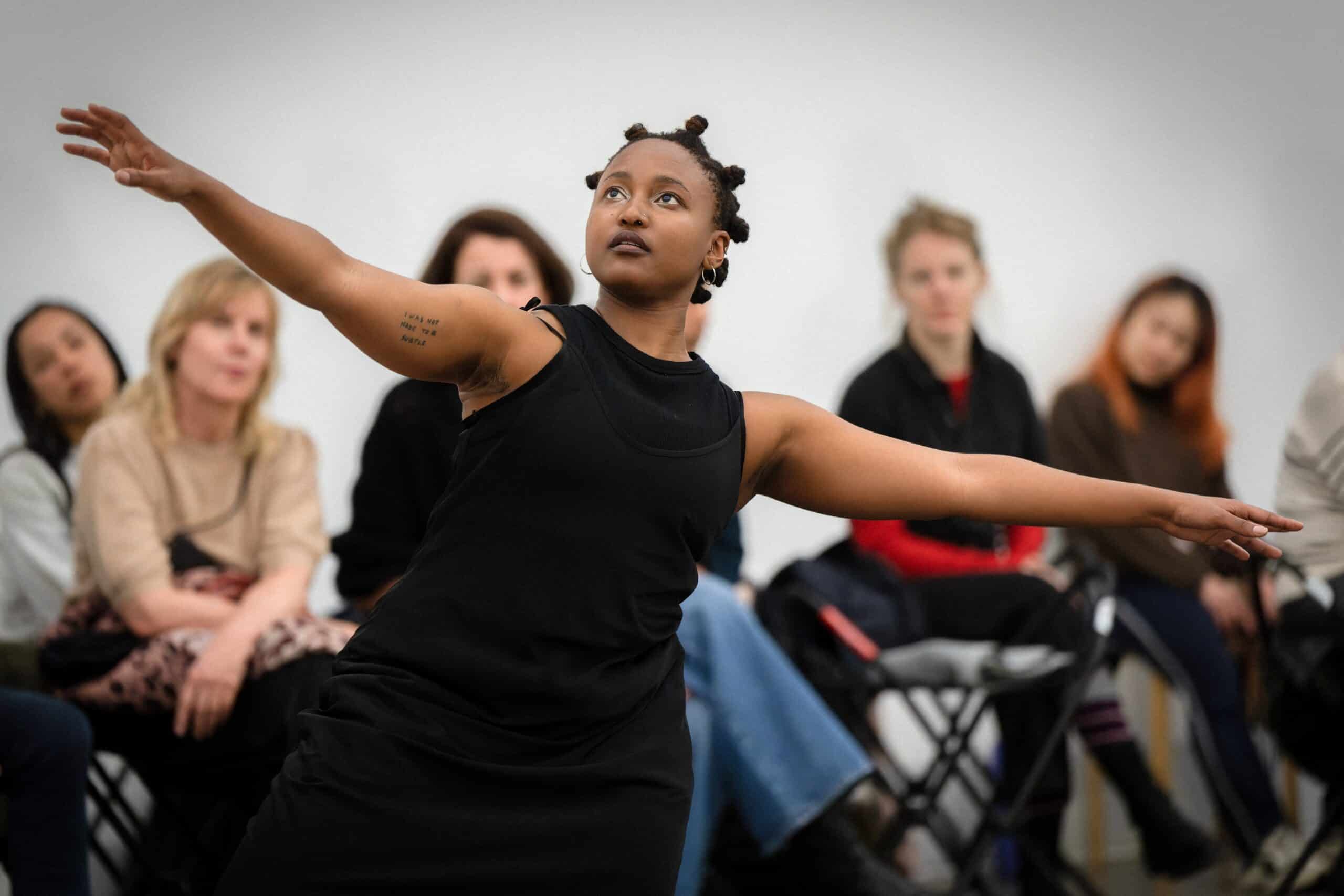
(Re)Spacing
10.11.2026, 7pm
As part of the event series (Re)Spacing organized in cooperation with Stadttheater Gießen, members of the dance ensemble develop choreographies and performances that respond to the preceding exhibition.
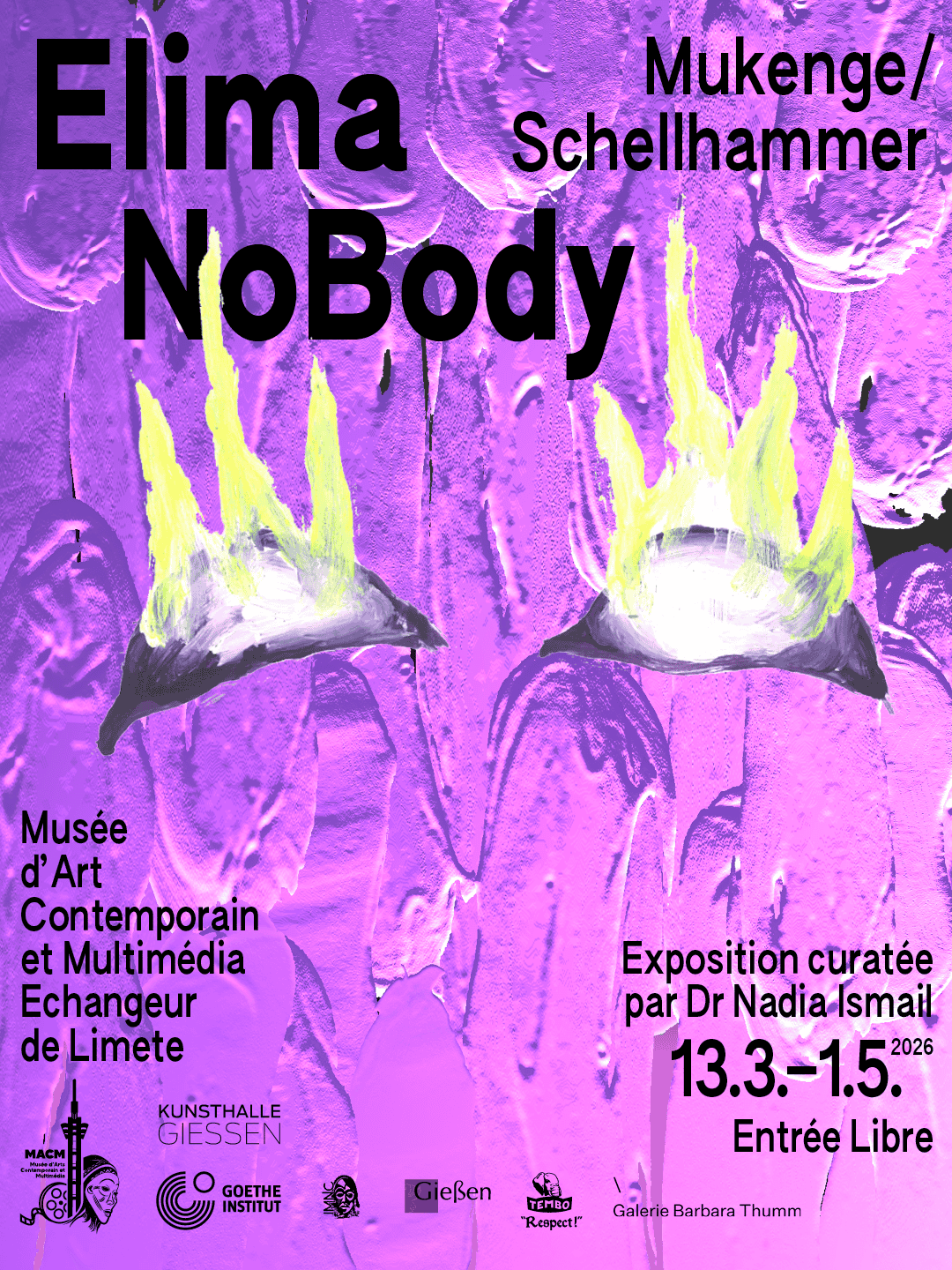
Mukenge / Schellhammer
Elima – NoBody
Curated by Dr. Nadia Ismail
At the Museum of Contemporary Art and Multimedia, Kinshasa
Duration: March 13 – May 1, 2026
Opening: March 13, 2026 // 6:00 pm
“But is it possible to imagine a work of art without a creator, without an artist who made it?” [Valentin-Yves Mudimbe]
With Elima – NoBody, the transnational artist duo Christ Mukenge and Lydia Schellhammer present an exhibition that foregrounds questions of authorship, corporeality, and collective existence. The works operate at the intersection of installation, performative practice, and conceptual research, developing an artistic language that deliberately distances itself from individualized authorship.
Mukenge/Schellhammer’s approach and methodology are deeply shaped by the art movement Partagisme, which originated in Kinshasa in Central Africa:
“Partagisme designates a movement of radically collective practice in Kinshasa that was founded in 2014 by artists together with students from the Académie des Beaux-Arts de Kinshasa. The term derives from the French verb partager (to share) and, through the addition of the suffix ‘-isme,’ becomes a theory of collective authorship.” [Christ Mukenge]
Partagisme understands sharing, collective action, and the dissolution of hierarchical structures as aesthetic strategies. Several people work on a piece according to previously defined agreements, so that individual signatures increasingly merge into one another. Mukenge/Schellhammer take this idea one step further. They increasingly understand their work not as the result of two artistic positions, but as the expression of an autonomous entity: the DUO. This functions as an independent artistic system that generates decisions, processes, and appearances without being clearly reducible to individual authorship. This shift is also visible in the exhibition title Elima – NoBody — the body becomes secondary, withdraws, or continuously transforms. The DUO’s multimedia approach is consistently interwoven: the physical brushstroke transitions into a digital world, only to reappear moments later as an object in “real space,” while presence and absence are negotiated simultaneously.
The title Elima – NoBody also refers to knowledge, memory, and disembodiment. The exhibition explores how identity emerges when the subject dissolves and artistic production is conceived as a relational, polyphonic practice. Spaces, materials, and narrative fragments form a structure in which the DUO appears as an acting agent — not as the sum of two artists, but as an autonomous presence.
With Elima – NoBody, Mukenge/Schellhammer open an important discourse on autonomy, cultural identity, collectivity, and the possibility of art beyond the individual self. The exhibition invites viewers to rethink authorship and to experience art as a process of shared, continually evolving existence.
“This is also very important for our artistic work, which has developed out of this local context. In 2024, we declared the DUO to be a being independent of us. Over the course of our many years of collaboration, a third style emerged from our respective artistic methods, forms of expression, and visual habits: the visual language of the DUO. It has become an autonomous entity with its own formal characteristics and its own aesthetics, a two-headed monster. We want to present the emergence of this being here by letting the DUO itself speak.” [Mukenge / Schellhammer]
A cooperation between the Musée d’Art Contemporain et Multimédia Kinshasa and Kunsthalle Giessen.
With the kind support of the Goethe-Institut Kinshasa.
Joel Kenda, Director Echangeur
Dr. Nadia Ismail, Director Kunsthalle Giessen and Curator of the Exhibition
Mwano Studio, Graphic Design
Mohsen Hazrati, 3D Design
Edwige Dro, Translation and Editing
With Elima – NoBody, the transnational artist duo Christ Mukenge and Lydia Schellhammer present an exhibition that foregrounds questions of authorship, corporeality, and collective existence. The works operate at the intersection of installation, performative practice, and conceptual research, developing an artistic language that deliberately distances itself from individualized authorship.
Mukenge/Schellhammer’s approach and methodology are deeply shaped by the art movement Partagisme, which originated in Kinshasa in Central Africa:
“Partagisme designates a movement of radically collective practice in Kinshasa that was founded in 2014 by artists together with students from the Académie des Beaux-Arts de Kinshasa. The term derives from the French verb partager (to share) and, through the addition of the suffix ‘-isme,’ becomes a theory of collective authorship.” [Christ Mukenge]
Partagisme understands sharing, collective action, and the dissolution of hierarchical structures as aesthetic strategies. Several people work on a piece according to previously defined agreements, so that individual signatures increasingly merge into one another. Mukenge/Schellhammer take this idea one step further. They increasingly understand their work not as the result of two artistic positions, but as the expression of an autonomous entity: the DUO. This functions as an independent artistic system that generates decisions, processes, and appearances without being clearly reducible to individual authorship. This shift is also visible in the exhibition title Elima – NoBody — the body becomes secondary, withdraws, or continuously transforms. The DUO’s multimedia approach is consistently interwoven: the physical brushstroke transitions into a digital world, only to reappear moments later as an object in “real space,” while presence and absence are negotiated simultaneously.
The title Elima – NoBody also refers to knowledge, memory, and disembodiment. The exhibition explores how identity emerges when the subject dissolves and artistic production is conceived as a relational, polyphonic practice. Spaces, materials, and narrative fragments form a structure in which the DUO appears as an acting agent — not as the sum of two artists, but as an autonomous presence.
With Elima – NoBody, Mukenge/Schellhammer open an important discourse on autonomy, cultural identity, collectivity, and the possibility of art beyond the individual self. The exhibition invites viewers to rethink authorship and to experience art as a process of shared, continually evolving existence.
“This is also very important for our artistic work, which has developed out of this local context. In 2024, we declared the DUO to be a being independent of us. Over the course of our many years of collaboration, a third style emerged from our respective artistic methods, forms of expression, and visual habits: the visual language of the DUO. It has become an autonomous entity with its own formal characteristics and its own aesthetics, a two-headed monster. We want to present the emergence of this being here by letting the DUO itself speak.” [Mukenge / Schellhammer]
A cooperation between the Musée d’Art Contemporain et Multimédia Kinshasa and Kunsthalle Giessen.
With the kind support of the Goethe-Institut Kinshasa.
Joel Kenda, Director Echangeur
Dr. Nadia Ismail, Director Kunsthalle Giessen and Curator of the Exhibition
Mwano Studio, Graphic Design
Mohsen Hazrati, 3D Design
Edwige Dro, Translation and Editing

Ökologie der Geister
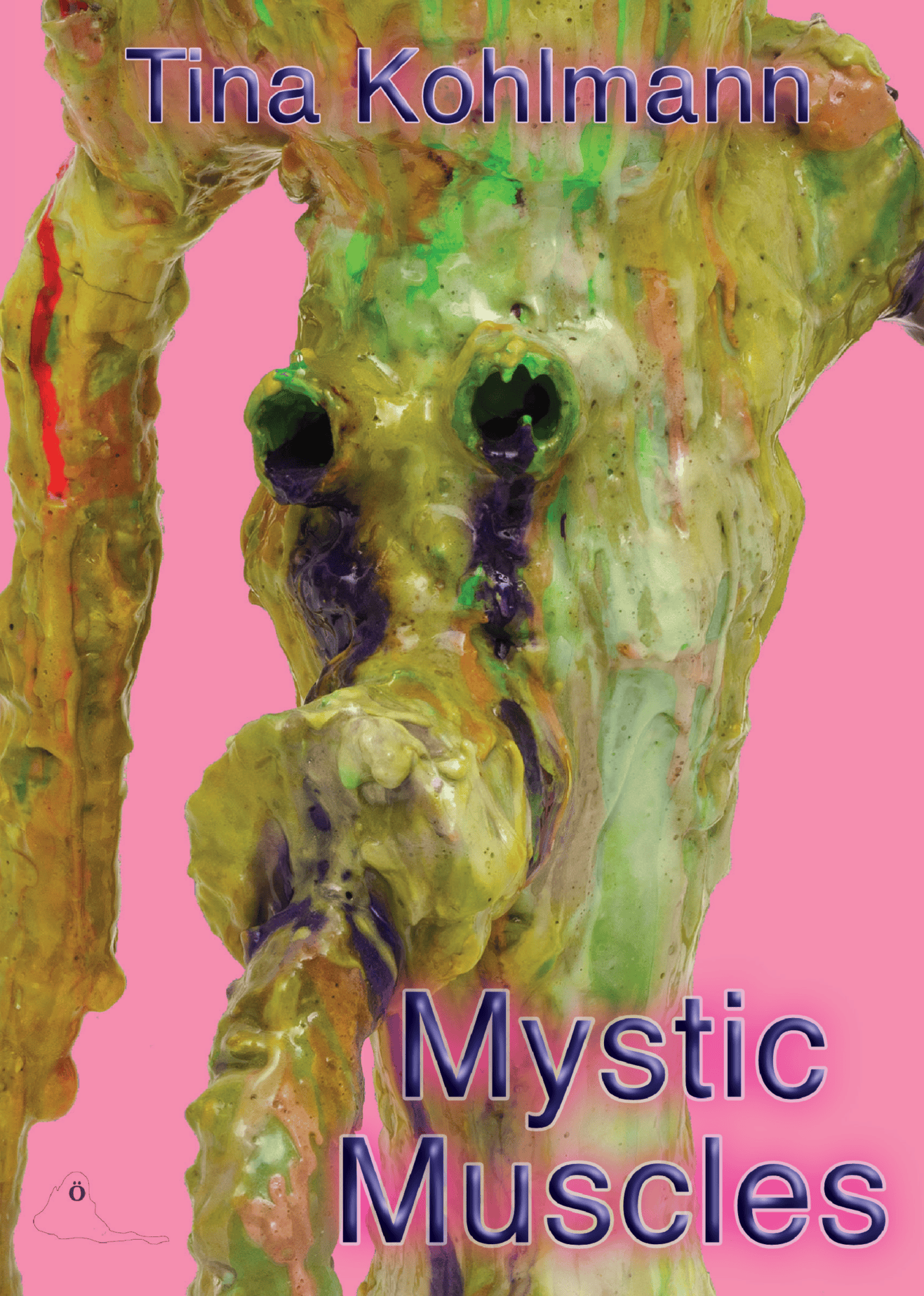
Kick-off event exhibition Tina Kohlmann: Mystic Muscles
February 13, 2026, 7 pm at the Blumen Corso, Johannesstraße 22, 35390 Gießen
A collaboration with Justus Liebig University
Official Greeting: Frank-Tilo Becher, Mayor of the City of Giessen
Introduction: Dr. Nadia Ismail, Director KUNSTHALLE GIESSEN and Prof. Martin Schepers, Professor of Painting and Drawing, Institute of Art Education, Justus Liebig University Giessen
Duration
14.02. – 31.05.2026
Opening hours:
Wed – Fri 2 – 7 pm, Sat 10am – 3 pm, and by appointment
We warmly invite you to the exhibition Tina Kohlmann. Mystic Muscles at the “Institute for Ghost Research,” aka Blumen Corso.
In her oeuvre, the artist engages with fringe sciences, mythology, anthropology, and ritual aesthetics. For the former Blumen Corso building, also serving as the project’s festival center, she has developed a site-specific installation of masks, figures, and artifacts that reference the history of the listed heritage building. Mystic Muscles functions as an allegory of the invisible forces that translate artistic ideas into sensorial forms, while also alluding to Kohlmann’s mythologically inflected beings, so-called non-humans.
Ökologie der Geister (Eng. Ecology of Spirits) is a collaborative project of Kunsthalle Giessen and the Institute of Art Education at Justus Liebig University that engages with the social upheavals currently destabilizing existing relations and leading to profound uncertainties. At the same time, it seeks constructive approaches toward new ways of shaping society: through artistic means, sites in Giessen are temporarily transformed into open stages for democratic thinking and action, as well as into spaces for individual stories. Ecology of Spirits brings art into the public realm—accessible, participatory, and surprising. It invites people of all generations to engage with democratic values, sustainability, and the spirits of history and the present. It also asks about the individual perspectives of the city’s inhabitants. To this end, significant locations in Giessen are artistically activated, inclusively experienced, and mediated. In this way, art connects the city’s public spaces with the individual stories of its population.
The eighteen-month project (February 2026 to summer 2027) begins with an opening event at the memorial site Erstaufnahmelager (6 February), followed by an artistic activation titled “Mystic Muscles” at the festival center Blumencorso (Opening 13 February) by the Frankfurt-based artist Tina Kohlmann.
Tina Kohlmann (born 1977 in Worms; lives and works in Frankfurt am Main) is a Germany-trained artist with an international exhibition practice and extensive experience in residency programs and institutional contexts. She studied at the Hochschule für Gestaltung Offenbach (Diploma in Visual Communication) and at the Städelschule Frankfurt under Michael Krebber.
Kohlmann has received numerous grants and fellowships, including a travel grant from the Hessian Cultural Foundation (Arctic Circle), a six-month New York fellowship from Künstlerhaus Schloss Balmoral, a one-year fellowship from Künstlerhilfe Frankfurt, and the Ottilie Roederstein Fellowship with her collective HazMatLab. She has been artist-in-residence in Greenland, Iceland, India, Hungary, Norway, the United States, Estonia, Switzerland, and Finland, most recently at Serlachius in Mänttä (Finland, 2026), KH Messen in Ålvik (Norway, 2025), and Leveld Kunstnartun (Norway, 2024).
Introduction: Dr. Nadia Ismail, Director KUNSTHALLE GIESSEN and Prof. Martin Schepers, Professor of Painting and Drawing, Institute of Art Education, Justus Liebig University Giessen
Duration
14.02. – 31.05.2026
Opening hours:
Wed – Fri 2 – 7 pm, Sat 10am – 3 pm, and by appointment
We warmly invite you to the exhibition Tina Kohlmann. Mystic Muscles at the “Institute for Ghost Research,” aka Blumen Corso.
In her oeuvre, the artist engages with fringe sciences, mythology, anthropology, and ritual aesthetics. For the former Blumen Corso building, also serving as the project’s festival center, she has developed a site-specific installation of masks, figures, and artifacts that reference the history of the listed heritage building. Mystic Muscles functions as an allegory of the invisible forces that translate artistic ideas into sensorial forms, while also alluding to Kohlmann’s mythologically inflected beings, so-called non-humans.
Ökologie der Geister (Eng. Ecology of Spirits) is a collaborative project of Kunsthalle Giessen and the Institute of Art Education at Justus Liebig University that engages with the social upheavals currently destabilizing existing relations and leading to profound uncertainties. At the same time, it seeks constructive approaches toward new ways of shaping society: through artistic means, sites in Giessen are temporarily transformed into open stages for democratic thinking and action, as well as into spaces for individual stories. Ecology of Spirits brings art into the public realm—accessible, participatory, and surprising. It invites people of all generations to engage with democratic values, sustainability, and the spirits of history and the present. It also asks about the individual perspectives of the city’s inhabitants. To this end, significant locations in Giessen are artistically activated, inclusively experienced, and mediated. In this way, art connects the city’s public spaces with the individual stories of its population.
The eighteen-month project (February 2026 to summer 2027) begins with an opening event at the memorial site Erstaufnahmelager (6 February), followed by an artistic activation titled “Mystic Muscles” at the festival center Blumencorso (Opening 13 February) by the Frankfurt-based artist Tina Kohlmann.
Tina Kohlmann (born 1977 in Worms; lives and works in Frankfurt am Main) is a Germany-trained artist with an international exhibition practice and extensive experience in residency programs and institutional contexts. She studied at the Hochschule für Gestaltung Offenbach (Diploma in Visual Communication) and at the Städelschule Frankfurt under Michael Krebber.
Kohlmann has received numerous grants and fellowships, including a travel grant from the Hessian Cultural Foundation (Arctic Circle), a six-month New York fellowship from Künstlerhaus Schloss Balmoral, a one-year fellowship from Künstlerhilfe Frankfurt, and the Ottilie Roederstein Fellowship with her collective HazMatLab. She has been artist-in-residence in Greenland, Iceland, India, Hungary, Norway, the United States, Estonia, Switzerland, and Finland, most recently at Serlachius in Mänttä (Finland, 2026), KH Messen in Ålvik (Norway, 2025), and Leveld Kunstnartun (Norway, 2024).

Fig.: Tina Kohlmann, Alteration of the Gap, 2020. Courtesy of the artist.

Fig.: Installation view, Sibylle Ruppert at Wilhelm Hallen, Berlin
Kunsthalle goes to Berlin: On the occasion of Berlin Art Week, the Kunsthalle presented Sibylle Ruppert at the Wilhelm Hallen.
Saturday, September 6 – Sunday, September 14, 2025
A collaboration with Wilhem Hallen, Berlin
Curated by Dr. Nadia Ismail
On the occasion of Berlin Art Week 2025, the KUNSTHALLE GIESSEN presented a comprehensive solo exhibition of Frankfurt-born artist Sibylle Ruppert (1942–2011) at the Wilhelm Hallen in Reinickendorf. The presentation was part of HALLEN 06, the sixth edition of the art festival, which this year celebrated its largest iteration to date with more than 9,000 square meters of exhibition space.
Writing in the German daily taz, Anna Meinecke noted:
“The Kunsthalle Giessen occupies a space with grotesque-erotic imagery by Sibylle Ruppert, a friend of HR Giger. Director Nadia Ismail hopes for synergies that will benefit both the artist and the institution.
‘Ruppert was ahead of her time, and in a male-dominated art world her masterful drawings—at times featuring violent, pornographic content—were not appreciated,’ she says. ‘I hope she will receive the long-overdue recognition she deserves, even if posthumously.’ The presence at the Wilhelm Hallen is intended to contribute to this.”


Fig: Aisling O’Carroll, The Temple of Science, installation view, 2024. Photo: Moritz Bernoully
INSIDE OUT #4
Aisling O’Carroll
The Temple of Science
04.11.- 10.11.24
Opening: Monday, 04.11.24, 6 pm
Exhibition in the Window of the Kunsthalle and online here
In cooperation with Panel on Planetary Thinking, Justus-Liebig-Universität Giessen
Curated by Theresa Deichert

Fig.: Aisling O’Carroll
The Temple of Science examines the entwined geological, glaciological, and human histories of the Unteraar glacier in the Bernese Alps through a reconstruction of the Hôtel des Neuchâtelois. The Hôtel des Neuchâtelois was an improvised mountain hut occupied by a group of glaciologists during their summer expeditions in 1840 and 1841. The hut was built under the shelter of a huge erratic block of micaceous schist found on the Unteraar glacier’s medial moraine. The mountain hut was lost when the boulder broke apart in the winter of 1842. Its brief existence registers a moment when geological, glaciological, and human timescales converged in the valley.
The Hôtel has since been romanticized as the ‘Temple of Science’ in Western scientific and Alpine narratives, bolstering the authority and intrepidity of the expeditioners in the landscape. Using evidence from both fieldwork and archives, this 1:5 scale reconstruction of the hut offers an alternative ‘Temple of Science’ for today. In place of the original dry-stone wall, the mirrored enclosure of this version reflects and invites different perspectives — from both humans and non-humans. It aims to expand whose knowledge is valued in the Temple of Science. The reconstruction encourages fresh ways of understanding long-term planetary changes, helping us rethink dominant models of environmental knowledge.
Aisling O‘Carroll is a designer, researcher, and landscape architect. Her work uses experimental methods to reconstruct landscape histories from diverse material archives, including drawings, photographs, written accounts, geological records, and botanical material. She is a Lecturer at The Bartlett School of Architecture, UCL, where she is currently completing her PhD in Architectural Design.
Accompanying Programm
Opening + Meet & Greet
with Aisling O’Carrol and Charlotte Wrigley
Monday, 04.11.2024, 6:00 pm
Kunsthalle Giessen
Film & Artist Talk (in English):
Tuesday, 05.11.2024, 6:30 pm
Last Things (Deborah Stratman, 2023)
Talk with Aisling O‘Carroll & Lukáš Likavčan
Kinocenter Giessen, Bahnhofstrasse 34, 35390 Giessen
Download the invite here
The Hôtel has since been romanticized as the ‘Temple of Science’ in Western scientific and Alpine narratives, bolstering the authority and intrepidity of the expeditioners in the landscape. Using evidence from both fieldwork and archives, this 1:5 scale reconstruction of the hut offers an alternative ‘Temple of Science’ for today. In place of the original dry-stone wall, the mirrored enclosure of this version reflects and invites different perspectives — from both humans and non-humans. It aims to expand whose knowledge is valued in the Temple of Science. The reconstruction encourages fresh ways of understanding long-term planetary changes, helping us rethink dominant models of environmental knowledge.
Aisling O‘Carroll is a designer, researcher, and landscape architect. Her work uses experimental methods to reconstruct landscape histories from diverse material archives, including drawings, photographs, written accounts, geological records, and botanical material. She is a Lecturer at The Bartlett School of Architecture, UCL, where she is currently completing her PhD in Architectural Design.
Accompanying Programm
Opening + Meet & Greet
with Aisling O’Carrol and Charlotte Wrigley
Monday, 04.11.2024, 6:00 pm
Kunsthalle Giessen
Film & Artist Talk (in English):
Tuesday, 05.11.2024, 6:30 pm
Last Things (Deborah Stratman, 2023)
Talk with Aisling O‘Carroll & Lukáš Likavčan
Kinocenter Giessen, Bahnhofstrasse 34, 35390 Giessen
Download the invite here


Fig: The body of a dead Russian soldier in the car of a search party. The bodies collected are taken to the local morgue. Ukrainian officers estimate that around 100 Russian soldiers died in the attack. Voznesenk, 15.03.2022. Photo courtesy Vincent Haiges.
Panel discussion
Depictions of Excessive Use of Force – Between Disturbance and Attraction
In cooperation with TraCe Research Center for Transformation of Political Violence
Wednesday, 30.10.24, 6 pm
On site or via Livestream: https://www.youtube.com/@TraCe_Violence/
How do images of violence affect us? When do they become voyeuristic spectacles, and when are they necessary documents? The public dialogue panel sheds light on depictions of excessive violence in reporting, art, and social media, and connects perspectives from both academia and practice. We aim to bring together views from the research center “Transformations of Political Violence” (TraCe) as well as from journalism, war photography, and exhibition practices to discuss the visual portrayal of excessive violence in various media contexts, especially focusing on the boundaries of what can be shown. The dialogue panel will be professionally livestreamed on YouTube.
Welcome: Nadia Ismail (Director of the Kunsthalle Giessen) & Katharina Lorenz (President of Justus Liebig University Giessen)
Panel: Larissa-Diana Fuhrmann (TraCe), Vincent Haiges (war photographer), Claudia Hattendorff (art historian), & Cornelia Wegerhoff (journalist)
Moderation: Tina Cramer
The event will be held in German.
Admission is free.
No pre-registration is required.
The panel marks the opening of the two-day 2024 annual academic conference of TraCe, which will feature 13 short presentations and three keynotes, spanning a wide conceptual arc: from international excessive violence and its legal frameworks in history and the present, to civil wars, domestic violence, and questions of justice following the use of excessive violence.
Excessive violence is not a new phenomenon. However, recent developments in the exercise of political violence increasingly challenge existing norms and practices aimed at curbing it. In the face of new forms of warfare, evolving terrorist violence, and rising disregard for international humanitarian law, humanity is under pressure. These transformations in political violence also challenge our ability to understand, analyze, and, ideally, mitigate or resolve the growing number and intensification of conflicts. The contributions at the 2024 TraCe annual conference, hosted by Justus Liebig University Giessen, will tackle the challenge of understanding these phenomena from sociocultural, historical, and empirical perspectives, while seeking normative solutions.
The research center “Transformations of Political Violence” (TraCe) is an interdisciplinary research network of five Hessian institutions: the Peace Research Institute Frankfurt (PRIF), Goethe University Frankfurt, Justus Liebig University Giessen, Philipps University Marburg, and Technical University Darmstadt. TraCe is supported by the Federal Ministry of Education and Research (BMBF).
Welcome: Nadia Ismail (Director of the Kunsthalle Giessen) & Katharina Lorenz (President of Justus Liebig University Giessen)
Panel: Larissa-Diana Fuhrmann (TraCe), Vincent Haiges (war photographer), Claudia Hattendorff (art historian), & Cornelia Wegerhoff (journalist)
Moderation: Tina Cramer
The event will be held in German.
Admission is free.
No pre-registration is required.
The panel marks the opening of the two-day 2024 annual academic conference of TraCe, which will feature 13 short presentations and three keynotes, spanning a wide conceptual arc: from international excessive violence and its legal frameworks in history and the present, to civil wars, domestic violence, and questions of justice following the use of excessive violence.
Excessive violence is not a new phenomenon. However, recent developments in the exercise of political violence increasingly challenge existing norms and practices aimed at curbing it. In the face of new forms of warfare, evolving terrorist violence, and rising disregard for international humanitarian law, humanity is under pressure. These transformations in political violence also challenge our ability to understand, analyze, and, ideally, mitigate or resolve the growing number and intensification of conflicts. The contributions at the 2024 TraCe annual conference, hosted by Justus Liebig University Giessen, will tackle the challenge of understanding these phenomena from sociocultural, historical, and empirical perspectives, while seeking normative solutions.
The research center “Transformations of Political Violence” (TraCe) is an interdisciplinary research network of five Hessian institutions: the Peace Research Institute Frankfurt (PRIF), Goethe University Frankfurt, Justus Liebig University Giessen, Philipps University Marburg, and Technical University Darmstadt. TraCe is supported by the Federal Ministry of Education and Research (BMBF).